

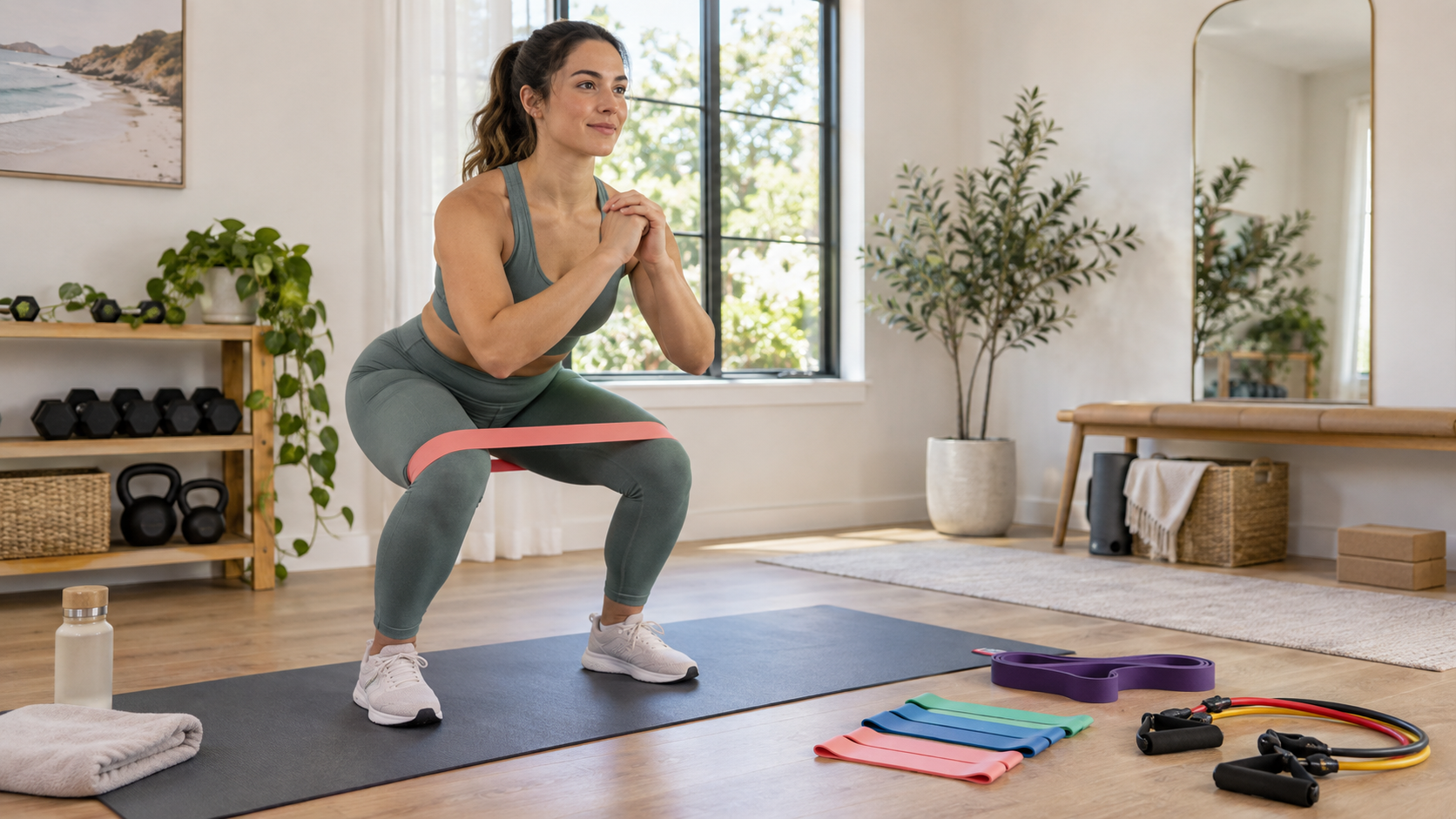
You do not need a rack of weights or a gym membership to build a useful strength routine. A well-planned resistance band workout for women at home using resistance bands can train your legs, glutes, back, chest, shoulders, and arms with equipment that fits inside a drawer or travel bag.
At Her Daily FitActions, the focus is practical fitness for busy women, and resistance bands fit that approach particularly well. They are portable, inexpensive compared with many home-gym setups, and easy to scale from a beginner session to a more challenging strength workout by changing band tension, range of motion, repetitions, or tempo
The goal of this routine is not to turn every exercise into a complicated band trick. It is to cover the main movement patterns with simple exercises you can repeat consistently. That means squatting, hinging, pulling, pressing, training the glutes, and adding a small amount of arm and upper-back work.
If you are still shopping for bands, review the site’s best resistance bands for women guide first. A mini loop is excellent for lower-body work, while a long loop or handled tube set gives you more options for full-body strength training.
Why Resistance Bands Can Work for Full-Body Strength at Home
Resistance bands are not just warm-up tools. The American College of Sports Medicine’s 2026 resistance-training guidance1 notes that elastic bands, bodyweight exercises, and home-based routines can produce meaningful improvements in strength, muscle growth, and physical function. ACSM also emphasizes that consistency matters more than making a program unnecessarily complicated.
Bands challenge your muscles differently from dumbbells because resistance generally increases as the band stretches. The beginning of a repetition may feel relatively easy, while the final part becomes harder. That makes controlled form especially important.
For beginners, the main advantages are practical:
· You can train in a bedroom, living room, or small home gym.
· A few bands can cover lower-body and upper-body exercises.
· Resistance is easy to adjust by changing bands, grip position, or stance.
· Bands are easy to pack when traveling.
· They make it simple to progress from bodyweight exercises without immediately buying heavy equipment.
The most important point is that the band still needs to challenge you. If you can complete every repetition with almost no effort, increase resistance, slow the movement, or add repetitions until the final few reps feel meaningfully harder while your form stays controlled.
What You Need for This Home Resistance Band Workout
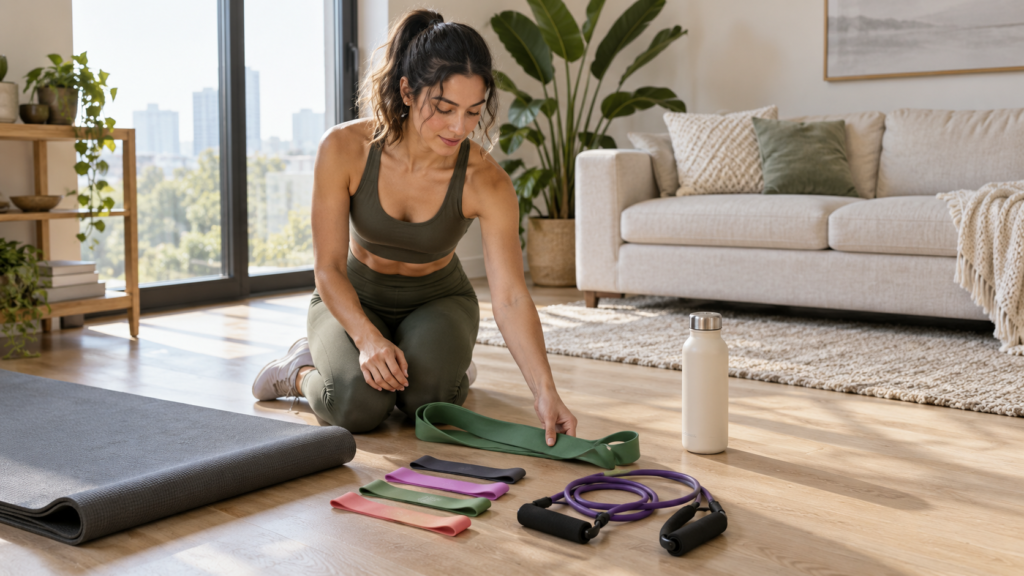
You can complete the routine with one long resistance band, but having two or three resistance levels makes progression easier. A mini loop is useful for glute work, while a long loop or tube band is better for rows, presses, hinges, and curls.
For the complete routine, use:
· One light resistance band
· One medium resistance band
· One heavier resistance band if available
· Optional mini loop band for glute work
· Exercise mat
· Stable footwear or a secure non-slip surface
If you are building a broader home setup, the site’s home workout equipment guide can help you decide which pieces of equipment are worth adding and which ones are unnecessary for your goals.
How to choose the right band tension
Use a band that lets you complete the planned repetitions with good control. The last few reps should feel challenging, but you should not need to twist, bounce, shorten the movement dramatically, or lose posture just to finish the set.
Beginner workout structure
Start with two sets of each exercise. After one or two weeks, move to three sets if the routine feels manageable. Rest about 45 to 90 seconds between sets, or longer if you need it to maintain good form.
The Full-Body Resistance Band Workout for Women
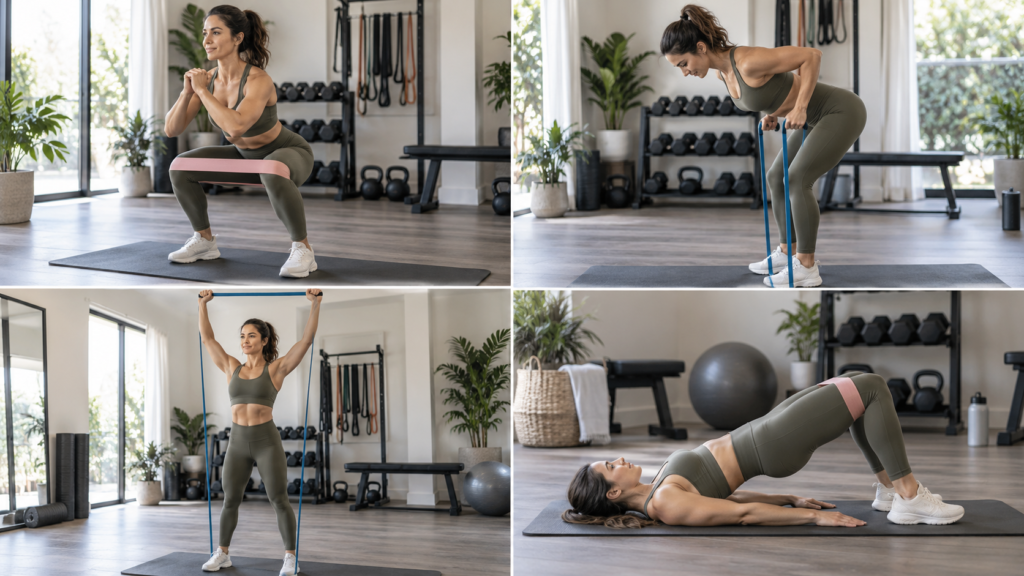
This routine uses eight movements to train the major muscle groups. ACSM’s resistance-training guidance2 recommends training all major muscle groups at least two days per week and building gradually. For a beginner, two full-body sessions per week is a sensible starting point; a third session can be added if recovery is good.
| Exercise | Sets | Reps | Main Muscles |
| 1. Banded Squat | 2-3 | 10-15 | Quads, glutes, hamstrings |
| 2. Band Romanian Deadlift | 2-3 | 10-15 | Hamstrings, glutes, back |
| 3. Bent-Over Band Row | 2-3 | 10-15 | Back, rear shoulders, arms |
| 4. Band Chest Press | 2-3 | 8-15 | Chest, shoulders, triceps |
| 5. Standing Band Overhead Press | 2-3 | 8-12 | Shoulders, triceps |
| 6. Mini-Band Glute Bridge | 2-3 | 12-20 | Glutes, hips |
| 7. Band Biceps Curl | 2-3 | 10-15 | Biceps |
| 8. Band Pull-Apart | 2-3 | 12-20 | Upper back, rear shoulders |
1. Banded Squat
Stand on the middle of a long band with your feet around shoulder-width apart. Hold the ends or handles near shoulder height. Sit your hips back and down as if you were sitting into a chair. Keep your knees tracking in the same direction as your toes, then push through your feet to stand.
Beginner modification: Use a lighter band or perform bodyweight squats first.
2. Band Romanian Deadlift
Stand on the band with feet about hip-width apart and hold the ends in front of your thighs. Keep a small bend in the knees, push your hips backward, and lower your hands toward your shins while keeping your spine neutral. Drive your hips forward to return to standing.
Think about moving through the hips rather than turning the exercise into a squat.
3. Bent-Over Band Row
Stand on the band and hinge forward slightly. Keep your chest open and core braced. Pull the band toward your ribs while squeezing your shoulder blades together. Lower slowly instead of letting the band snap your arms forward.
4. Band Chest Press
For a no-anchor version, place a long loop band around your upper back, holding one side in each hand. Press your hands forward until your arms are nearly straight, then return slowly. Keep the band across the upper back rather than the neck.
5. Standing Band Overhead Press
Stand securely on the middle of the band and hold the handles or ends at shoulder height. Press upward until your arms are extended without aggressively arching your lower back. Lower under control.
6. Mini-Band Glute Bridge
Place a mini loop above your knees and lie on your back with your knees bent. Press your knees gently outward against the band, squeeze your glutes, and lift your hips. Pause briefly at the top, then lower slowly.
For more lower-body training, use the site’s best home leg firming workout for women on a separate day or rotate it with this full-body routine.
7. Band Biceps Curl
Stand on the band with your arms by your sides. Keep your elbows close to your torso and curl your hands toward your shoulders. Avoid leaning backward to create momentum.
8. Band Pull-Apart
Hold a light band in front of you at roughly chest height. Keep a slight bend in the elbows and pull the band apart until your arms move out to the sides. Squeeze your upper back, then return slowly. Use a light band; this exercise does not require heavy resistance
How to Progress Without Making the Workout Complicated
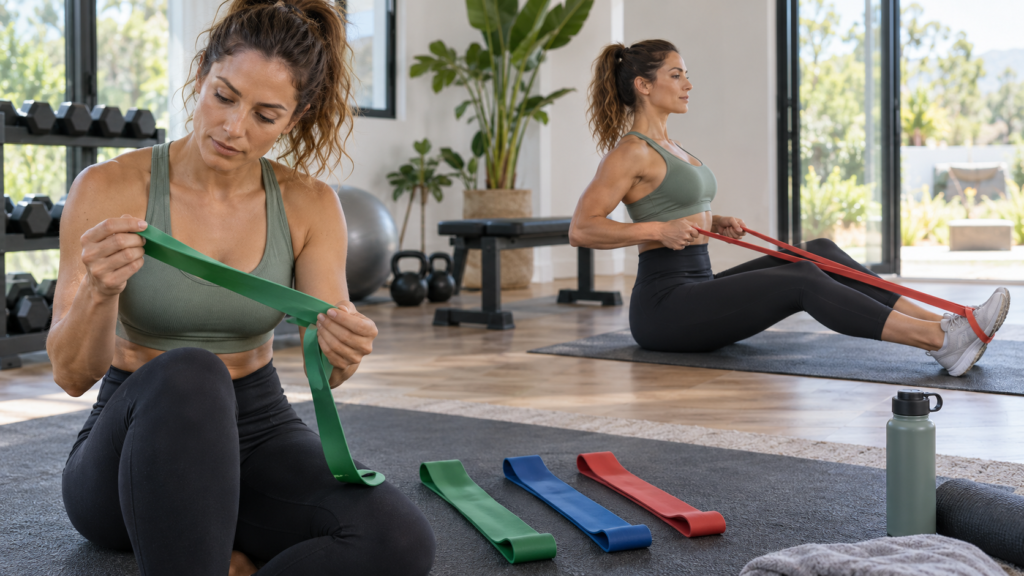
A resistance-band routine only keeps working if the exercises become harder as you adapt. ACSM’s 2026 position-stand summary3 emphasizes matching training to the individual and progressing over time rather than relying on complicated methods.
Use one progression at a time:
· Move from 2 sets to 3 sets.
· Add 2 to 3 repetitions per set while keeping form clean.
· Switch to a slightly stronger band.
· Shorten the band by widening your stance or gripping lower, if the band is designed for that use.
· Slow the lowering phase of each repetition.
· Add a brief pause where the band is most stretched.
How often should beginners do this workout?
Start with two non-consecutive days per week. If soreness is manageable, your energy is good, and your form remains solid, you can progress to three sessions. You do not need to perform the same full-body routine every day.
Do you need to train to failure?
No. For general fitness, you can stop a set while you still feel that one or two good repetitions might be possible. ACSM’s 2026 overview found that advanced methods such as consistently training to momentary failure are not necessary for the average healthy adult to make progress.
Resistance-band safety
Check each band before training. Replace it if you see cracks, thinning, tears, damaged stitching, or worn hardware. Keep bands away from sharp edges and control the return portion of each repetition instead of letting the band snap back.
If an exercise causes sharp pain, stop rather than forcing the movement. People who are pregnant, recently postpartum, recovering from injury, or managing a health condition should get individualized guidance when necessary.
A Simple Weekly Resistance Band Workout Plan
You do not need a seven-day schedule. A simple week can look like this:
| Day | Workout |
| Monday | Full-body resistance band workout |
| Tuesday | Walking, mobility, or rest |
| Wednesday | Optional light cardio or rest |
| Thursday | Full-body resistance band workout |
| Friday | Walking or mobility |
| Saturday | Optional third strength session or another home workout |
| Sunday | Rest / light activity |
If you want a longer mixed-equipment session on another day, the site’s 30-minute full-body home workout is a useful progression because it combines strength and cardio with more equipment.
Frequently Asked Questions
Can resistance bands build muscle?
Yes. Resistance bands can provide enough resistance to challenge muscles and support strength and muscle development when the exercises are progressed over time. ACSM’s 2026 guidance specifically recognizes elastic-band and home-based resistance training as effective approaches.
What resistance band should a beginner use?
Use a light or medium band that allows controlled repetitions through a comfortable range of motion. Different exercises may require different tensions. Your legs can often handle more resistance than smaller upper-body movements.
Is a 20-minute resistance band workout enough?
It can be enough for a useful session if you focus on compound movements and train consistently. A short workout you complete every week is more valuable than a complicated hour-long plan you rarely do.
How many times a week should women use resistance bands?
For a beginner full-body plan, two non-consecutive strength sessions per week is a sensible starting point. Progress to three if recovery is good and you want more training volume.
Are resistance bands good for glutes?
Yes. Mini loops and long bands work well for glute bridges, squats, lateral steps, hip abduction, and other lower-body exercises. Choose enough resistance that the movement is challenging without pulling your knees or hips out of position.
Can I do this workout without a door anchor?
Yes. This routine is deliberately built so you can complete it without a door anchor. The squat, deadlift, row, chest press, overhead press, glute bridge, curl, and pull-apart can all be performed with bands and your body.
Start with Two Sessions and Build from There
The best home resistance band workout is not the one with the most exercises. It is the one you can repeat, progress, and fit into your actual week.
Start with two sets of the eight exercises and use a band tension that lets you move with control. When the routine becomes easier, add a few repetitions, move to three sets, or increase the resistance. You do not need to change everything at once.
If you want more workout variety, visit Her Daily FitActions and explore the site’s home workout equipment guide, home leg workout for women, and 30-minute full-body home workout to build a weekly routine that combines strength, cardio, and practical home training.
REFERENCES & CITATIONS
1. American College of Sports Medicine. ACSM Publishes Updated Resistance Training Guidelines. American College of Sports Medicine. Cited for the effectiveness of elastic bands and home-based resistance training, and for the emphasis on consistency.
2. American College of Sports Medicine. 5 Things to Know About Creating an Effective Resistance Training Plan. American College of Sports Medicine. Cited for training all major muscle groups at least two days per week and progressing gradually.
3. American College of Sports Medicine. Resistance Training Guidelines Update 2026. American College of Sports Medicine. Cited for individualized progression and the finding that advanced techniques such as consistent training to momentary failure are not required for general results.

