

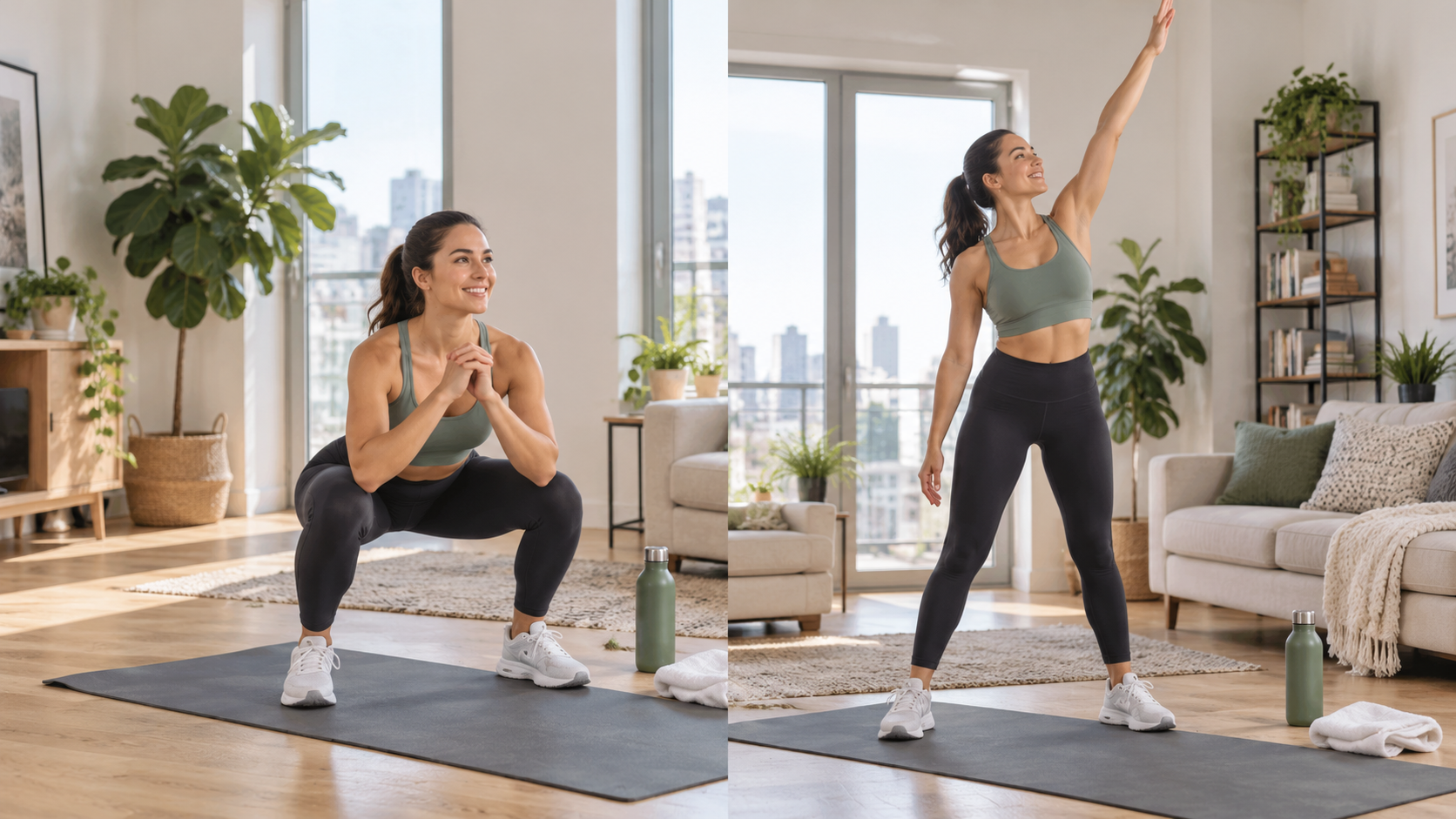
When you want to exercise but jumping, burpees, sprinting in place, or high-impact cardio does not fit your body, your space, or your energy level, a 20 minute low impact full body workout can be a much more realistic option. You can still raise your heart rate, train your legs and glutes, move your upper body, and challenge your core without repeatedly leaving the floor.
At Her Daily FitActions, the goal is to make home fitness practical for busy women. This routine is built for that exact purpose: 20 minutes, no jumping, no equipment, and enough modifications that a beginner can reduce the range of motion while a more experienced exerciser can increase pace and depth.
Low impact does not automatically mean low effort. You can make simple movements challenging by moving continuously, using a larger comfortable range of motion, adding arm movements, increasing pace, and controlling the lowering phase of each exercise. The important difference here is that at least one foot stays on the floor during the cardio-style movements, so there is no repeated jumping.
This article gives you a complete follow-along structure: a 2-minute warm-up, a 16-minute full-body circuit, and a 2-minute cool-down. If you already publish workout videos on the site, place the video directly below this introduction so readers can either follow along visually or use the written routine.
Why a Low-Impact Workout Can Still Be Effective
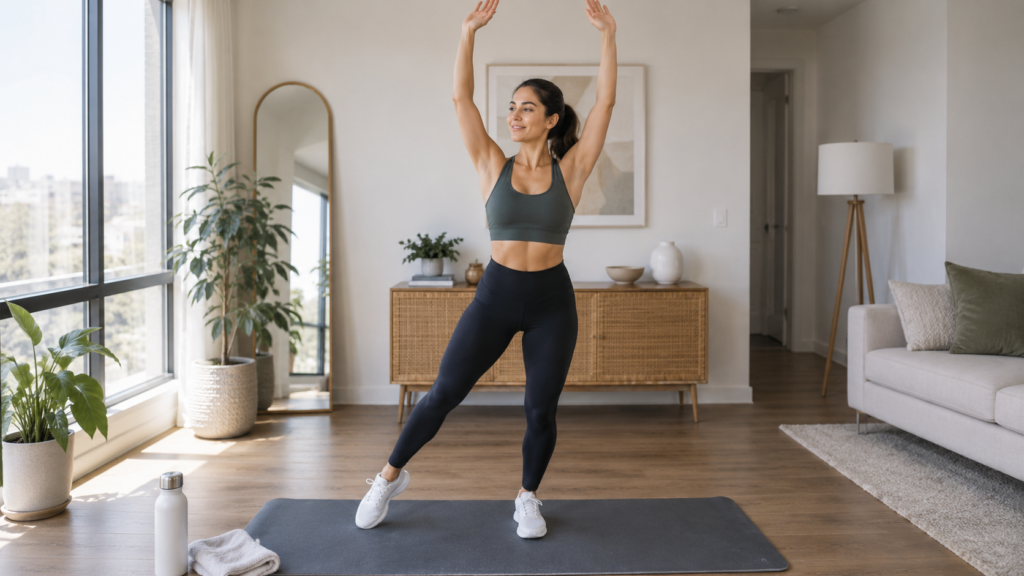
Low-impact exercise is useful because it lets you keep moving while reducing repeated impact forces from jumping and running. Cleveland Clinic sports-medicine guidance on low-impact exercise1 notes that low-impact exercise can help people stay active while putting less stress on the joints, and describes it as a practical place to start for people who are hesitant to exercise at maximal effort.
That does not mean every low-impact movement is appropriate for every person. A deep squat, reverse lunge, or fast knee drive can still be uncomfortable if you have a specific knee, hip, back, balance, or medical issue. Low impact describes the style of movement, not a guarantee that a particular exercise is pain-free for everyone.
The routine also fits the broader activity guidelines. CDC guidance for adults2 recommends at least 150 minutes of moderate-intensity aerobic activity per week plus muscle-strengthening activity on at least two days. The CDC also emphasizes that activity can be broken into smaller chunks rather than completed all at once.
A 20-minute session therefore does not need to be your entire fitness plan. It can be one useful piece of the week, especially on days when a longer workout is unrealistic.
· Apartment-friendly: no jumping means less impact noise through the floor.
· Beginner-friendly: every move can be slowed down or shortened.
· Time-efficient: 20 minutes is easier to schedule before work, during lunch, or in the evening.
· No equipment: you only need enough room to step forward, back, and side to side.
· Easy to progress: increase pace, depth, arm range, or work-to-rest ratio when the routine becomes easier.
If indoor walking is your preferred low-impact cardio, you can also compare the site’s best walking pads for small spaces for a separate way to add more movement at home without turning every session into a formal workout.Low-impact exercise is useful because it lets you keep moving while reducing repeated impact forces from jumping and running. Cleveland Clinic sports-medicine guidance on low-impact exercise1 notes that low-impact exercise can help people stay active while putting less stress on the joints, and describes it as a practical place to start for people who are hesitant to exercise at maximal effort.
That does not mean every low-impact movement is appropriate for every person. A deep squat, reverse lunge, or fast knee drive can still be uncomfortable if you have a specific knee, hip, back, balance, or medical issue. Low impact describes the style of movement, not a guarantee that a particular exercise is pain-free for everyone.
The routine also fits the broader activity guidelines. CDC guidance for adults2 recommends at least 150 minutes of moderate-intensity aerobic activity per week plus muscle-strengthening activity on at least two days. The CDC also emphasizes that activity can be broken into smaller chunks rather than completed all at once.
A 20-minute session therefore does not need to be your entire fitness plan. It can be one useful piece of the week, especially on days when a longer workout is unrealistic.
· Apartment-friendly: no jumping means less impact noise through the floor.
· Beginner-friendly: every move can be slowed down or shortened.
· Time-efficient: 20 minutes is easier to schedule before work, during lunch, or in the evening.
· No equipment: you only need enough room to step forward, back, and side to side.
· Easy to progress: increase pace, depth, arm range, or work-to-rest ratio when the routine becomes easier.
If indoor walking is your preferred low-impact cardio, you can also compare the site’s best walking pads for small spaces for a separate way to add more movement at home without turning every session into a formal workout.
How Hard Should This 20-Minute Workout Feel?
Because fitness levels differ, a no-jumping workout may feel easy to one person and moderately challenging to another. The CDC talk-test guidance3 explains that moderate-intensity activity generally allows you to talk but not sing, while vigorous activity makes it difficult to say more than a few words without pausing for breath.
For this routine, aim for a controlled effort around 5 to 7 out of 10. You should feel warmer and breathe harder during the circuit, but you should still be able to maintain good movement quality. A beginner may stay closer to 4 or 5 out of 10. A fitter exerciser can increase pace while keeping the workout low impact.
Before You Start: 2-Minute Warm-Up
The American Heart Association4 recommends warming up gradually before moderate or vigorous exercise so heart rate and breathing increase progressively. For a short 20-minute workout, use a simple two-minute movement warm-up rather than starting at full pace.
| Time | Movement | Focus |
| 0:00-0:30 | Easy march in place | Relax shoulders and gradually raise breathing rate |
| 0:30-1:00 | Step touch with arm circles | Warm shoulders and hips |
| 1:00-1:30 | Shallow bodyweight squats | Warm knees, hips and glutes |
| 1:30-2:00 | Alternating knee lifts with gentle reach | Prepare for full-body movement |
The 16-Minute Low-Impact Full-Body Circuit
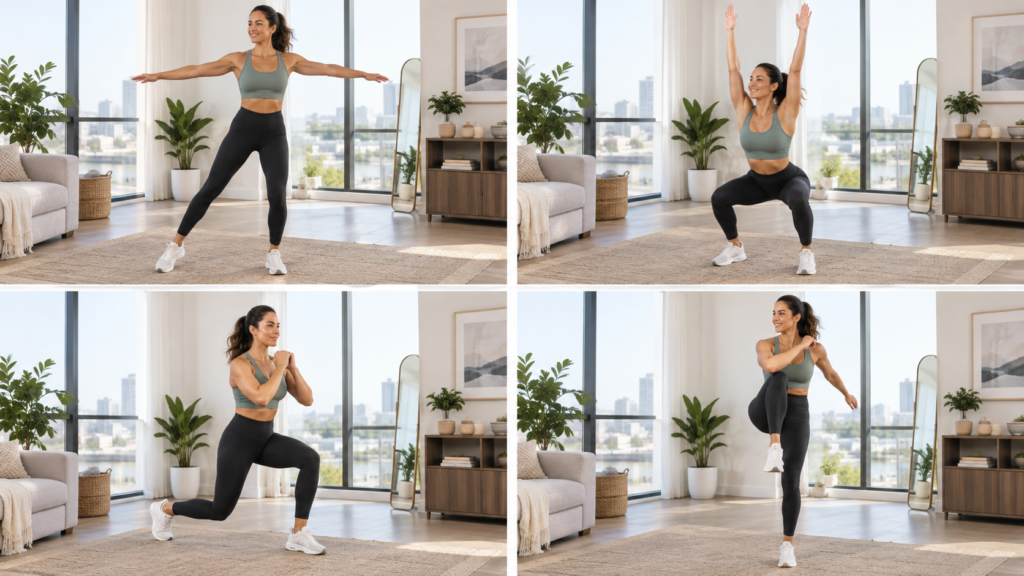
Perform each exercise for 40 seconds, then take 20 seconds to transition. Complete all eight exercises once, then repeat the full circuit for a second round. That gives you 16 minutes of work after the warm-up.
| Exercise | Time | Main Focus | Beginner Option |
| 1. Step Jacks | 40 sec | Cardio, shoulders, hips | Smaller side step and lower arm reach |
| 2. Squat to Reach | 40 sec | Quads, glutes, shoulders | Shallow squat or chair tap |
| 3. Alternating Reverse Lunge / Toe Tap | 40 sec | Legs, glutes, balance | Tap one foot back without bending deeply |
| 4. Standing Cross-Body Knee Drive | 40 sec | Core, hips, cardio | Slow march with cross-body reach |
| 5. Wall or Counter Push-Up | 40 sec | Chest, shoulders, triceps | Use a more upright wall angle |
| 6. Side Step + Punch | 40 sec | Cardio, shoulders, coordination | Smaller step and slower punches |
| 7. Standing Glute Kickback + Arm Sweep | 40 sec | Glutes, posture, shoulders | Hold a chair lightly for balance |
| 8. Marching Reach + Calf Raise | 40 sec | Cardio, calves, shoulders | March without calf raise |
1. Step Jacks
Stand tall with your feet together or hip-width apart. Step your right foot out while your arms sweep overhead, return to center, then repeat on the left. Keep one foot on the floor at all times. Increase pace only if you can keep the movement controlled.
2. Squat to Reach
Stand with feet around shoulder-width apart. Sit your hips back into a comfortable squat, then stand and reach both arms overhead. Keep the squat depth appropriate for your mobility. A chair behind you can provide a clear target if you are learning the movement.
3. Alternating Reverse Lunge or Toe Tap Back
Step one foot backward and lower only as far as you can control, then return to standing and switch sides. If lunges bother your knees or balance, simply tap the foot behind you and keep most of your weight on the front leg.
4. Standing Cross-Body Knee Drive
Bring one knee upward while drawing the opposite elbow or hand toward it. Return the foot to the floor and switch sides. The goal is controlled trunk rotation rather than yanking the knee as high as possible.
5. Wall or Counter Push-Up
Place your hands on a wall or sturdy counter at about chest height. Keep your body in a straight line, bend your elbows to bring your chest toward the surface, then press away. A wall is easier; a lower counter angle is harder.
6. Side Step + Punch
Step to the right and punch one or both arms forward at chest height, then step left and repeat. Keep the shoulders relaxed and rotate only as much as feels comfortable. This movement keeps the heart rate up without jumping.
7. Standing Glute Kickback + Arm Sweep
Stand tall and extend one leg gently behind you while sweeping your arms backward or outward. Squeeze the glute without arching your lower back. Alternate sides. Hold the back of a stable chair if balance is a concern.
8. Marching Reach + Calf Raise
March in place while reaching your arms overhead. Every few steps, rise onto the balls of your feet for a controlled calf raise. If balance feels uncertain, skip the calf raise and keep marching.
Want a more strength-focused session on another day? The new resistance band workout for women at home is a better choice when your priority is progressive resistance rather than cardio-style movement.
How to Modify the Workout for Your Fitness Level
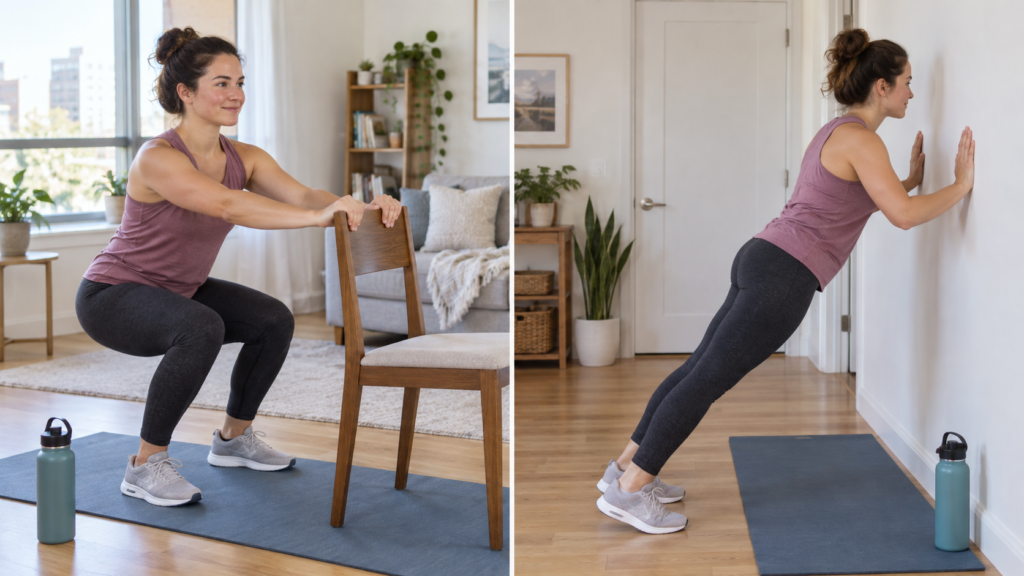
A good beginner low impact workout should be easy to scale without making you feel as though you have failed the “real” version. Modifications are part of the workout, not a penalty.
· Reduce squat or lunge depth if your knees or hips feel uncomfortable.
· Use a wall instead of a counter for push-ups.
· Move at half speed while learning the sequence.
· Keep your hands at shoulder height instead of overhead if reaching causes discomfort.
· Hold a stable chair lightly during kickbacks or knee drives if balance is limited.
· Take 30 or 40 seconds of rest instead of 20 seconds when needed.
· Stop the timer and recover fully if you feel dizzy, faint, unusually short of breath, or experience sharp pain.
The CDC notes that physical activity intensity is relative to the individual5. A movement that feels moderate for one person can feel vigorous for another. Use your breathing, coordination, and ability to maintain form as feedback rather than trying to match someone else’s pace.
If you have a chronic health condition, are returning after a long period of inactivity, are pregnant or recently postpartum, or have ongoing joint or back pain, individualized advice may be appropriate. Mayo Clinic’s 2026 exercise guidance for people with chronic conditions6 recommends discussing exercise type and intensity with a healthcare professional when a long-term condition affects what is safe or comfortable.
Finish with a 2-Minute Cool-Down
Do not finish the second circuit and immediately drop onto the sofa. The American Heart Association’s warm-up and cool-down guidance7 recommends gradually reducing activity rather than stopping suddenly.
| Time | Movement | Goal |
| 18:00-18:30 | Slow march | Let breathing begin to settle |
| 18:30-19:00 | Step touch + shoulder rolls | Relax upper body |
| 19:00-19:30 | Gentle calf and hamstring stretch | Reduce tension through legs |
| 19:30-20:00 | Chest opener + deep breathing | Return to a comfortable resting pace |
How to Use This Workout During the Week
This routine works well as a short cardio-and-movement day, but it should not be the only thing you do forever. A balanced week can combine low-impact cardio, strength work, walking, and recovery.
| Day | Example Activity |
| Monday | 20-minute low-impact full-body workout |
| Tuesday | Strength or resistance-band workout |
| Wednesday | Walk or recovery activity |
| Thursday | 20-minute low-impact workout or another cardio session |
| Friday | Strength workout |
| Saturday | Optional walk, mobility or longer full-body session |
| Sunday | Rest or light activity |
If you want a lower-body-only session, use the site’s 20-minute leg workout for home. If you have more time and want a harder mixed workout, the 30-minute full-body home workout is the more demanding option.
Frequently Asked Questions
Is a 20-minute low-impact workout enough?
It can be a useful workout, especially when performed consistently. It does not need to meet your entire weekly activity target in one session. The CDC specifically notes that weekly activity can be broken into smaller chunks, so shorter workouts can contribute to your total.
Can low-impact exercise still raise your heart rate?
Yes. Continuous stepping, squatting, reaching, punching, and knee-drive movements can raise breathing and heart rate without jumping. The exact intensity depends on your fitness level and pace.
Is this workout good for beginners?
Yes, because every movement has a lower-intensity option. Beginners should use a comfortable pace, smaller ranges of motion, and extra rest as needed.
Is no jumping the same as low impact?
Not exactly, but no-jumping routines are commonly designed to reduce repeated impact. Some non-jumping exercises can still place meaningful load on the knees, hips, wrists, or back, so exercise choice and technique still matter.
Can I do this workout in an apartment?
Yes. The routine avoids jumping and requires only a small area to step side to side and backward. If noise is a concern, wear supportive shoes and use a suitable exercise mat on a stable surface.
Can I add dumbbells or resistance bands?
You can, but do not add resistance to every move immediately. If you want a dedicated strength session, the resistance-band workout on Her Daily FitActions is a cleaner way to progress because the exercises are selected specifically for resistance training.
How often can I do a low-impact full-body workout?
Two to four times per week can fit many general fitness routines, depending on intensity and what other exercise you do. You do not need to repeat the exact same circuit every day. Include strength work and recovery as part of the week.
No Jumping Does Not Mean No Challenge
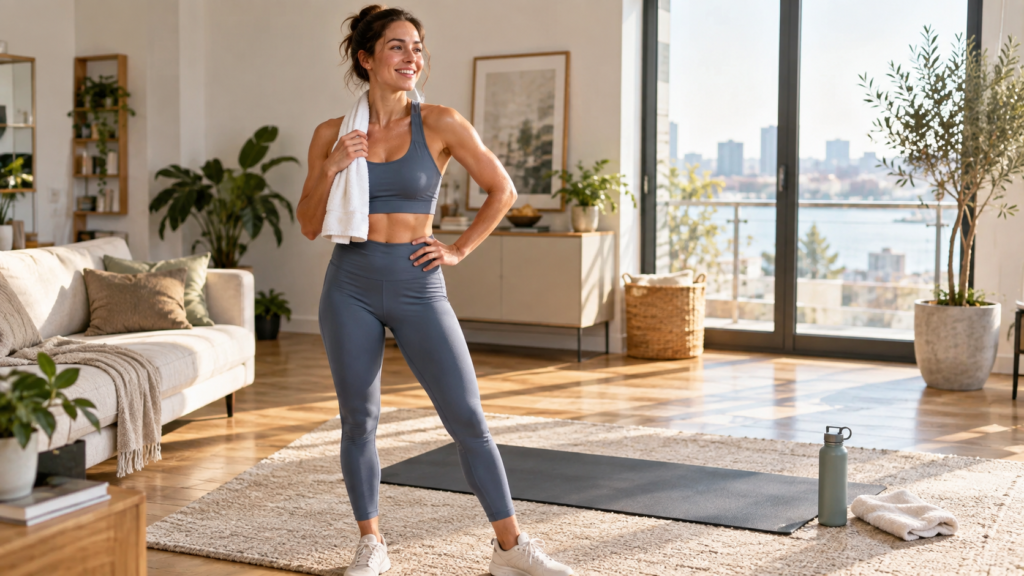
A short no jumping workout for women can still be productive when the routine is structured and you work at an appropriate intensity. You do not need burpees, box jumps, or running in place to make 20 minutes count.
Use the first round to learn the movements and the second round to make them slightly stronger and more confident. If you are new to exercise, slow down and finish with energy left. If you are already fit, increase the pace, squat depth, arm range, or work interval while keeping the routine low impact.
For more practical workouts and home-fitness ideas, visit Her Daily FitActions. You can also rotate this routine with the resistance band workout for women at home for strength and the best walking pads for small spaces guide if you want an easy way to add more low-impact walking to your day.
REFERENCES & CITATIONS
1. Cleveland Clinic. Low-Impact Exercises With High Calorie Burn. Cleveland Clinic. Cited for the general concept that low-impact exercise can reduce stress on the joints while helping people stay active.
2. Centers for Disease Control and Prevention. Adult Activity: An Overview. Centers for Disease Control and Prevention. Cited for current adult aerobic and muscle-strengthening activity guidelines and the ability to spread activity across the week.
3. Centers for Disease Control and Prevention. How to Measure Physical Activity Intensity. Centers for Disease Control and Prevention. Cited for moderate-intensity talk-test guidance and relative intensity.
4. American Heart Association. Warm Up, Cool Down. American Heart Association. Cited for gradual warm-up before exercise.
5. Centers for Disease Control and Prevention. How to Measure Physical Activity Intensity. Centers for Disease Control and Prevention. Cited for the fact that relative exercise intensity differs by fitness level.
6. Mayo Clinic. Exercise and Chronic Disease: Get the Facts. Mayo Clinic. Cited for individualized exercise guidance when chronic conditions affect exercise choices.
7. American Heart Association. Warm Up, Cool Down. American Heart Association. Cited for gradually reducing activity at the end of a workout.

